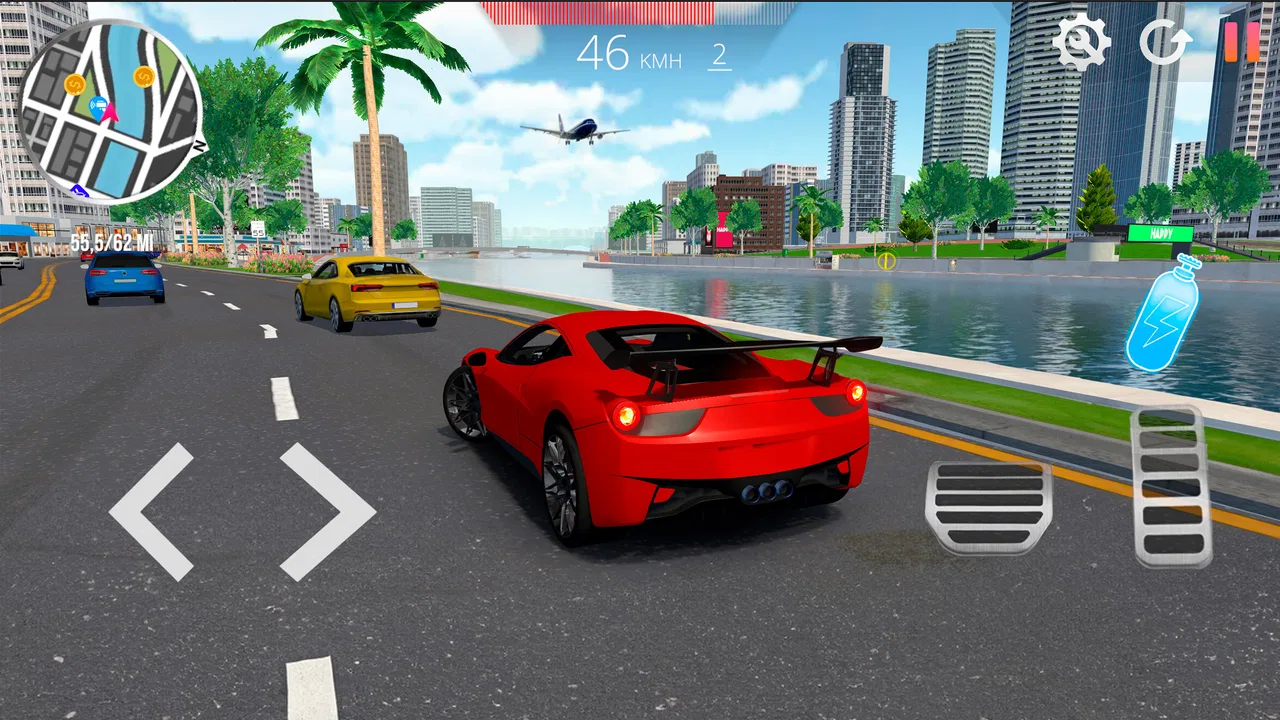
Car Real Simulator
- 4.6
- Rating
- 10.00M
- Installs
- Free
- Price

 Analysis by App-foxy
Car Real Simulator is the sort of racing game I open when I want a quick drive rather than a complicated competition. Developed by Cerebellium Apps, it focuses on 3D car handling and realistic-feeling driving, with a free entry point that makes it easy to try. After spending time with it, I see its main appeal in the straightforward idea: get behind the wheel, learn how the car responds, and enjoy the sensation of driving without needing to study a large game system first.
That simplicity is also what makes it interesting from an inclusive-use perspective. A racing game can look accessible because the basic goal is familiar, yet small details such as visual clarity, control precision, pace, and attention demands decide whether it feels comfortable. In my experience, this one is easiest to enjoy when you want a focused driving session and can adapt to its control style. It is less suitable if you need extensive customization for input, vision, hearing, or fatigue management.
How the driving experience feels in everyday use
The first thing I noticed is that the game presents itself as a simulator rather than a cartoon-style arcade racer. That changes how I approach each drive. I am not simply holding a button and watching a car fly around a track; I have to pay attention to steering, speed, and the way the vehicle settles after a turn. The realistic direction gives the game a calmer rhythm than many racing alternatives, although it also means mistakes can feel less forgiving.
You May Also Like

 Blood Strike: 2.5 Anniversary
Blood Strike’s Loadouts Turn Every Drop Into a Tactical Gamble
A close look at Blood Strike’s custom loadouts: how fast access to signature weapons reshapes its battle royale rhythm, rewards preparation, and narrows the gap between fights.

 Pandora - Music & Podcasts
Pandora’s Music Is Easy to Start, but Harder to Recover
Pandora’s strength is its low-effort path from a seed to a station. Its weak spot is how much confidence it asks you to place in connection, setup, and quiet recovery.

 8 Ball Pool
 Is Built on Rivalries, Rematches, and Routine
A close look at the rivalries, rematches, shared routines, and unanswered safety questions that turn a quick pool match into a persistent mobile community.

 Samsung Music
’s Quiet Strength Is Playing What You Already Own
Its reach comes less from spectacle than from dependable access to a personal library. That simplicity is both the app’s strongest retention engine and its ceiling.

 AccuWeather: Weather Radar
AccuWeather Review: A Quick, Clear Forecast for Everyday Decisions
For everyday plans, the best forecast is the one you can understand quickly. AccuWeather makes rain timing, radar, and local conditions easy to act on, with a few trade-offs.

 Hill Climb Racing
Why Hill Climb Racing Still Turns Crashes Into One More Run
A tiny car, a bumpy hill and one more upgrade: Hill Climb Racing keeps resurfacing because its simple chaos makes every near-miss feel personal.
More From Our News Desk



The game is free to download and is rated for Everyone, which makes it approachable for households where several people may want to try it. Its audience is broad: a casual player can use it for a short session, while someone who enjoys practicing vehicle control may stay longer to refine their approach. The current version is 2.1.20, and the game runs on Android 8.0 or later. That compatibility is useful for people who do not use a recent phone, though the experience will still depend on the device’s screen, performance, and touch response.
Its popularity is easy to understand. The game has passed ten million installs, with an average rating of 4.6 from roughly 120 thousand ratings and about 2.7 thousand written reviews. Those figures suggest that the basic driving concept connects with a large audience, but they should not be treated as a guarantee that every player will find the controls comfortable. A highly rated game can still be a poor fit for someone who needs larger interface elements, slower input demands, or alternative control methods.
Readable presentation and learning the route
For me, the most readable part of the experience is the direct relationship between what I see and what I need to do. The road, the car, and the direction of travel form the central visual information. I do not have to understand a large collection of menus before I can begin driving. That helps when I am playing during a short break and want to get moving quickly.
There is a useful difference between a game that is easy to start and one that is easy to master. Car Real Simulator is easy to start because its purpose is immediately clear. The more demanding part comes while driving, when I need to judge turns and react without losing control. Players who prefer a slower learning curve may appreciate practicing on their own rather than being pushed into a crowded competitive environment.
I recommend beginning with short sessions instead of trying to prove your skill immediately. A few minutes of gentle steering gives you a better sense of how much movement the game expects from your finger or device. This is one of the small habits that improved my experience: I stopped treating the first attempt as a race and used it as a control check. That approach is especially helpful for younger players or anyone who finds fast visual changes tiring.
Navigation is also easier when I keep the phone in a stable position. Holding it loosely while moving around can make steering feel inconsistent, even if the game itself is responding correctly. A stand or a firm grip can reduce unnecessary movement and make the screen easier to follow. This is not a special feature of the game, but it is a practical adjustment that makes a noticeable difference during longer drives.
Motor demands, vision, and sound
The main physical demand is precise touch control. Racing naturally asks for quick corrections, and a simulator-style game makes those corrections feel important. Players with limited finger mobility, tremors, or difficulty maintaining pressure may find the driving more demanding than a simple tap-based racer. I would not describe the controls as universally accessible simply because the game is easy to understand.
One useful strategy is to make smaller, deliberate movements instead of constantly correcting the car. Oversteering often creates a chain of extra corrections, which increases both frustration and physical effort. I found that looking farther ahead on the road, rather than staring only at the car, helped me prepare for turns earlier. That reduces the need for sudden movements and can make the session feel less tiring.
Visual access depends heavily on the phone being used. A larger display may make the road easier to follow, while a small screen can compress important information and leave less room for accurate touch input. Players with low vision may also need to adjust the device’s general display settings, but I would not assume that those changes will enlarge every game element or improve every visual cue inside the game.
People who are sensitive to motion should approach the realistic driving presentation carefully. Even without a highly exaggerated style, movement across a road can be uncomfortable for some players. I prefer testing the game for a short period in a well-lit room before committing to a longer session. If visual motion causes discomfort, stopping early is wiser than trying to push through it.
Sound can be useful for atmosphere, but I would not rely on audio alone to understand what is happening. Someone who is deaf or hard of hearing can still engage with the visual driving task, yet any information communicated mainly through sound could be less available. Conversely, players who are sensitive to engine noise or prefer quiet play may want to lower the device volume. The game is more flexible in a shared environment when played silently, although visual attention then becomes even more important.
When it works well outside a perfect gaming setup
A realistic everyday use case is a short session while waiting for an appointment or during a commute break, provided the player is safely stationary. The game suits that moment because the central activity is clear and does not require learning a long story or coordinating with a team. I can play for a little while, put it down, and return later without feeling that I have abandoned a complicated narrative.
It can also work as a low-pressure introduction to driving games for someone who is not interested in aggressive competition. A parent, older relative, or first-time mobile racer may prefer learning how a car behaves over chasing complicated rankings. The Everyone rating supports that broad audience, but supervision and common-sense device use still matter for younger players, especially when optional purchases are available.
Players who share a phone should think about comfort and visibility. A person with stronger vision or faster reactions may naturally dominate if everyone uses the same small screen, while another player may need more time to understand the steering. Taking turns without treating every attempt as a contest makes the game more welcoming. I also find that explaining the goal in plain language helps new players more than giving them a long list of driving tips.
The game is less convenient for people who need a completely hands-free experience, because the core activity depends on interacting with the device. It is also not my first choice for someone who wants a deep multiplayer community, a structured career, or a highly configurable simulation setup. In those cases, a more specialized racing title may offer better tools, even if it takes longer to learn or demands a newer device.
Costs, device limits, and attention barriers
The free price is a genuine advantage because it removes the biggest barrier to trying the driving model. At the same time, in-app purchases range from $0.99 to $99.99 per item. That wide range means I would be careful before handing the phone to a child or leaving purchasing decisions entirely unattended. The game can be sampled without paying, but optional spending should be treated as a separate decision rather than an automatic part of the experience.
For accessibility, cost is not only about the download. A player may need a larger device, a stand, headphones, or a different way to hold the phone, and those surrounding choices can affect the total effort of playing. The game’s free entry makes experimentation easier, but it does not solve physical or sensory barriers by itself. I would use the free version as a practical test: check whether the screen is readable, the controls are manageable, and the motion feels comfortable before considering any purchase.
Attention is another important factor. Driving requires continuous focus, so this is not an ideal game for someone who wants to glance away frequently or play while multitasking. A slower puzzle game may be a better alternative for a person who needs frequent pauses in visual concentration. On the other hand, the focused format can be positive for players who dislike crowded interfaces and prefer one clear task at a time.
Performance may vary across devices even though the minimum operating system is Android 8.0. A phone that technically meets the requirement may still offer a less comfortable session if its screen is small, its touch response is inconsistent, or the game does not feel smooth on that hardware. I would avoid judging the game from a single device alone, but I would also avoid assuming that an older compatible phone will deliver the same comfort as a newer one.
Where this simulator stands beside other racing games
Compared with an arcade racer, Car Real Simulator asks me to be more patient. Arcade games often reward dramatic swerves, fast boosts, and immediate excitement. Here, the appeal is closer to managing the car and learning its movement. That makes it a better match for someone who enjoys control and repetition, but a weaker choice for anyone looking for constant spectacle.
Compared with a full-scale racing simulation, it is easier to approach on a phone. I do not need to commit to a long setup before understanding the basic attraction. The trade-off is that players seeking professional-level tuning, extensive vehicle management, or a detailed competitive structure may eventually want something more specialized. I would choose this game for accessible driving practice, not as a replacement for every serious racing simulator.
It also differs from endless racers, where the usual goal is to survive as long as possible while avoiding obstacles. The simulator framing encourages me to think about the car’s path rather than simply react to an endless stream of hazards. That distinction matters for players who become overwhelmed by rapidly changing scenes. Still, the need to steer continuously means it is not automatically easier for people with motor difficulties.
One of my more useful observations is that the game rewards consistency more than frantic input. If I enter a turn already positioned sensibly, I need fewer corrections and can enjoy the driving more. This makes it a good practice tool for learning visual anticipation: look at the road shape, decide early, and let the car follow a controlled line. It is a modest skill, but it transfers better to other driving games than simply memorizing a button sequence.
Who should try it, and who should skip it
I would recommend it to players who want a free 3D racing game with a realistic driving feel, especially those who prefer practicing at their own pace. It is also a reasonable choice for families or friends who want a simple game to pass around, as long as everyone is comfortable with touch steering and the person responsible for the device manages purchases.
I would suggest trying it cautiously if you have motion sensitivity, limited hand control, low vision, or difficulty maintaining attention on moving visuals. The game may still be usable with device-level adjustments and a supportive setup, but I would not promise that those adjustments fully address every barrier. A title with explicit control remapping, stronger visual customization, or turn-based play would be a better option when those needs are central.
I would skip it if your main goal is a large online racing scene, a deep progression system, or a highly technical garage experience. The game’s strength is its direct driving focus. Asking it to provide the breadth of a much larger racing platform would lead to disappointment. It is best understood as a focused mobile driving experience rather than an all-purpose racing hub.
My final view is positive but measured. Car Real Simulator is most inclusive when the player can comfortably see the road, make repeated touch adjustments, and control the pace of the session. Its free access, Everyone rating, clear driving premise, and broad device compatibility lower the entry barrier, while the simulator-style handling gives patient players something to practice.
However, accessibility should not be confused with simplicity. The game does not remove the physical and sensory demands that come with steering a moving car on a small screen. I would install it, test it in a calm setting, adjust my grip and display setup, and judge it by comfort rather than by the rating alone. For casual drivers and people who enjoy careful control, it is worth trying; for players who need extensive accessibility options or a richer competitive structure, another racing game may be the kinder choice.
After trying it, I would describe Car Real Simulator to a friend as a straightforward, free driving game that rewards patience. It does not need exaggerated features to be enjoyable. Its best moments come from making a clean turn, reducing unnecessary corrections, and feeling more in control after a few attempts. That focused experience is exactly why it works for some players—and exactly why those who need slower, simpler, or more customizable interaction should test it before settling in.
FAQs for Car Real Simulator
01What is Car Real Simulator?
Car Real Simulator is a mobile game that offers a realistic driving experience with a variety of cars and environments. The game features advanced physics and dynamic weather conditions, providing players with an immersive and engaging driving simulation. It's available for both Android and iOS devices.
02Are there in-app purchases in Car Real Simulator?
Yes, Car Real Simulator includes in-app purchases. Players can buy upgrades, new cars, and customizations to enhance their gameplay experience. While the game is free to download, these optional purchases can provide additional features and benefits, allowing players to progress faster or enjoy premium content.
03What are the key features of Car Real Simulator?
Car Real Simulator boasts several key features, including realistic driving physics, a wide selection of vehicles, dynamic weather conditions, and various game modes such as free drive and challenges. The game also offers customizable controls, allowing players to tailor their driving experience to their preferences.
04Is Car Real Simulator suitable for all ages?
Car Real Simulator is generally suitable for a wide audience, but it is recommended for players aged 12 and above due to its realistic driving mechanics and complexity. Parents should review the game content and in-app purchase options to ensure it aligns with their preferences for younger players.
05Can I play Car Real Simulator offline?
Yes, Car Real Simulator can be played offline. However, some features, such as updates or certain multiplayer modes, may require an internet connection. Playing offline allows you to enjoy the core game experience without needing to connect to the internet, making it convenient for on-the-go gaming.
Pros
- Impressive graphics enhance realism.
- Wide range of cars to choose from.
- Realistic driving physics.
- Customizable controls for comfort.
- Frequent updates with new content.
Cons
- In-app purchases can be costly.
- Occasional glitches in multiplayer mode.
- Requires a stable internet connection.
- Some ads are intrusive during gameplay.
- Limited offline features available.

Car Real Simulator
Gallery